
Our purpose is to protect and enhance the environment for generations to come. As a business so closely associated with the environment, we are very aware of our environmental impact and obligations. We recognise that the abstraction, treatment and delivery of clean, safe drinking water, and the removal and safe disposal of wastewater all have implications for river and sea water quality, and we understand that the scale of our operations brings with it a scale of responsibility in how we manage our operational activities.
Our environmental commitments are set out within our Group Environmental Policy and are embedded across our strategy, including our 2025–2030 Business Plan and Double Materiality Assessment. These ensure we remain focused on the issues that matter most to our stakeholders and the environment.
We rely on the natural environment to deliver for our customers and communities, and our progress this year has been achieved against a backdrop of continued operational and environmental challenges, including the impacts of climate change and increasing demand for resilient infrastructure.
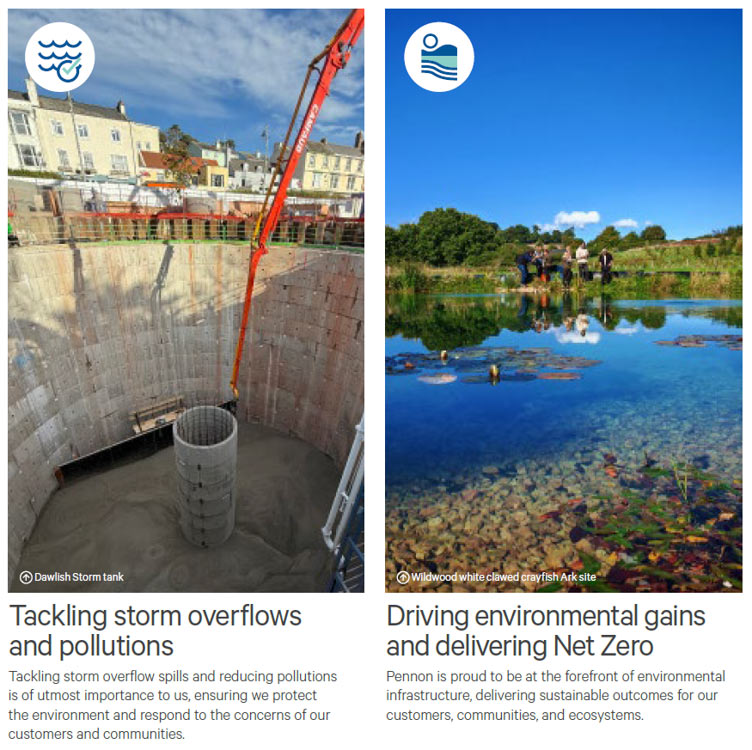
As we move into a period of significant investment to 2030, we remain focused on delivering against our key strategic priorities. Two of these are directly focused on environmental outcomes: reducing storm overflows and pollutions, and driving environmental gains and net zero.
Read more about the progress made against these key priorities in our Annual Report and Accounts 2025/26 here.
BREEAM
Pennon’s head office Peninsula House was refurbished to BREEAM Very Good standard in 2011. Our certificate can be found here.
For further details on our performance across a range of environmental metrics, read more in our ESG Databook.
Environment - Reducing our Environmental Impact
- Net Zero
- Climate Change
- Air Emissions
- Water management
- Effluent Management
- Waste Management
- Hazardous Waste
- Biodiversity
Our Net Zero Transition
Across Pennon, we recognise the urgent need to transition to a low carbon, climate resilient economy, aligned with the goals of the Paris Agreement and a 1.5°C pathway.
This year and for the start of AMP8, we have reviewed our strategic ambition to become a Net Zero organisation, setting our near term focus on achieving our emissions reduction goals through our near term science based targets and developing our longer term strategy through a Climate Transition Plan, to be published in the upcoming financial year.
Whilst our regulated businesses have made significant progress, achieving a 45% reduction in emissions towards their operational Net Zero ambition last year, we are cognisant of the shortcomings of that commitment, covering only operational greenhouse gas (GHG) emissions within our regulated businesses, with over 73% of the Group’s emissions occurring in our value chain, in other words, the Group’s scope 3 GHG emissions.
Building on the progress we are making as a Group against our near term GHG reduction targets, which have been revalidated by Science Based Targets initiative (SBTi) in April 2026, our Group’s Climate Transition Plan sets out our pathway to achieving Net Zero across all three emissions scopes by 2050 across the Group, aligned with the latest climate science and in reference to the SBTi Net Zero Standard.
Our plan will build on our current decarbonisation strategy to provide greater transparency on the levers, dependencies and milestones required to achieve Net Zero, ensuring we remain accountable to our stakeholders while contributing to a resilient and low carbon future.
For more details of our progress towards Net Zero, please see our Annual Report and Accounts 2025/26
GHG Emissions
Our GHG targets
Science-based targets
As a Group, we have committed to near term Science Based Targets (SBTs), giving us Scope 1, 2 and 3 emissions reduction targets to aim for by 2032/33.
Our targets were initially validated and approved by the Science Based Targets Initiative (SBTi) in May 2024, and this past year we have reaffirmed our commitment to the SBTi by rebaselining these targets to include SES Water, ensuring our SBTs remain relevant across our Group. SES EV charger
SBTs provide a clearly defined pathway for companies to reduce greenhouse gas emissions. Targets are considered ‘science based’ if they are in line with what the latest climate science deems necessary to meet the goals of the Paris Agreement ‑ limiting global warming to 1.5°C above pre industrial levels.
Our ‘rebased’ SBTs are set out below. These apply across the whole Pennon Group, including SES Water.
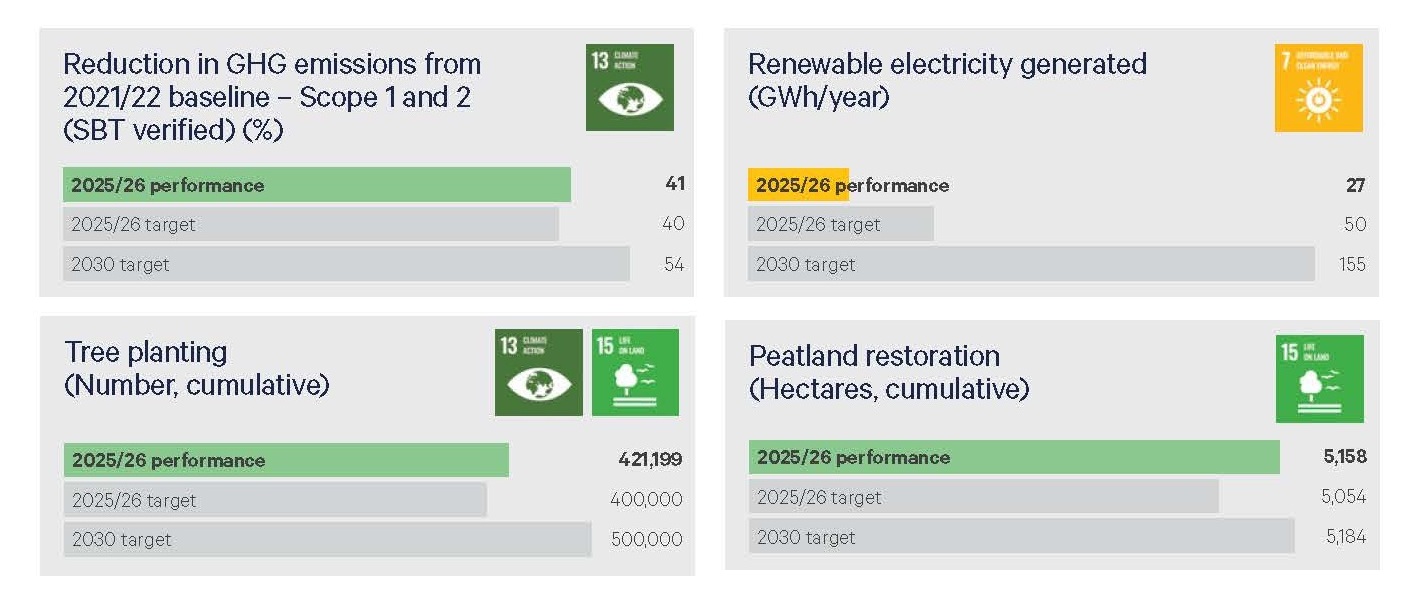
- The Group commits to a 63% reduction in absolute Scope 1 and market based Scope 2 emissions by 2032/33 from a 2021/22 base year.
- The Group commits to reduce absolute Scope 3 GHG emissions by 30% from fuels and energy related activities, wastes generated in operations, business travel, employee commuting, upstream leased assets and use of sold products over the same timeframe.
- The Group commits that 60% of its suppliers by emissions covering purchased goods and services, capital goods and upstream transportation and distribution will have science based targets by FY 2027/28.
- The Group commits to increase annual sourcing of renewable electricity to 100% by 2030/31.
GHG performance commitments
Our South West Water (including Bournemouth Water), Bristol Water and SES Water regulated businesses also have five GHG related performance commitments (PCs) reportable to our regulator Ofwat.
Four of the performance commitments relate to operational GHG’s where the measure is based on Scope 1 and 2 emissions and a subset of Scope 3 emissions that relate only to our operational activities.
Our operational GHG performance commitments are measured using the location based GHG accounting methodology where our purchase of renewable electricity from suppliers does not count towards our emissions reduction, whereas our Group science based targets use the market based greenhouse gas accounting methodology which does account for our renewable electricity purchase.
The fifth performance commitment is an embodied carbon measure that relates to activity under our capital investment programme and is a measure of tonnes of CO2 embodied in our investment in our capital projects as a proportion of our spend on those projects.
These performance commitments are all measured against the baseline values we calculated and forecast as part of our PR24 (2025–2030) business plan.
Carbon in decision-making and internal carbon price
We continue to integrate carbon into our decision-making processes, embedding it within planning, investment and operational activities across the Group.
We are working closely with our Amplify supply chain partners to embed this approach, ensuring carbon is a key consideration in project design and delivery, and supporting the adoption of lower-carbon solutions across our capital investment programme.
This forms part of our wider Green First approach, which prioritises low-carbon and nature-based solutions at the earliest stages of investment planning, helping to reduce both operational and embodied emissions.
Our Transition Plans
At Pennon, we recognise the need to transition to a low-carbon and climate-resilient economy in line with the Paris Agreement and a 1.5°C future. As a leading provider of water and wastewater services, we are committed to delivering a sustainable future while protecting the natural environment across our regions.
During the year, we revalidated our near-term Science Based Targets (SBTs) through the Science Based Targets initiative (SBTi), updating our baseline to reflect the inclusion of SES Water and alignment with the latest climate science. These targets provide a clear and credible pathway for reducing our greenhouse gas emissions in line with a 1.5°C trajectory.
We are focused on delivering against these targets through our decarbonisation strategy, supported by investment in renewable energy, operational efficiency and low-carbon infrastructure.
Alongside our near-term ambitions, we are developing a Group Climate Transition Plan, which will set out our pathway to Net Zero across all emissions scopes by 2050. This will provide greater transparency on the actions, dependencies and milestones required to achieve our long-term ambitions.
We continue to align our approach with emerging best practice, including the Transition Plan Taskforce (TPT) guidance, and will build on our disclosures over time as our transition planning evolves.
Climate adaptation
Assessing climate change risk and any potential impacts and possible mitigations on our various operations, assets and networks, remains an ongoing priority.
We have made good progress in mitigating the impacts of climate change and continue to embed climate resilience across our long-term planning frameworks. As climate-related risks evolve, we regularly monitor and review these plans to ensure they remain effective, which collectively are delivered through:
- Water Resource Management Plans (WRMPs) across South West Water, Bristol Water and SES Water, setting out long-term water supply strategies over 25 years
- Drainage and Wastewater Management Plans (DWMPs), supporting resilience and sustainable wastewater services
- Our 2025–2030 Business Plan, delivering investment to strengthen infrastructure, improve environmental outcomes and build resilience to climate change
These plans are regularly reviewed and updated to reflect evolving risks, including more frequent extreme weather events, population growth and environmental pressures.
- South West Water, Bristol Water and SES Water - Water Resource Management Plans for the next 25 years.
- South West Water - Drainage and Waste Water Management Plan for the next 25 years.
- South West Water, Bristol Water and SES Water - five-year business plan covering the period 2025-2030.
Each of these plans can be found on the relevant company website, as below:
For further details of how our business is preparing for climate change please see our latest Climate Change Adaptation Report
We are core members of the Water Resources West Country Water Resources group, established in 2017 to allow improved collaboration in water resources management in the South West of England.
Task Force on Climate-related Financial Disclosures’ (TCFD)

TCFD provides a framework setting out how businesses should integrate climate change risk and opportunities into their business strategy, governance, risk management and metrics and targets. Pennon support the Financial Stability Board Task Force on Climate-related Financial Disclosures’ (TCFD) recommendations that were introduced as mandatory reporting for 2022..
We operate in a changing environment where the impacts of climate change and biodiversity loss are increasingly evident. To remain resilient, we monitor climate risks, assess their implications, and embed these insights into our strategic planning and investment decisions.
Our disclosures under the TCFD and TNFD frameworks reflect our commitment to transparency, accountability, and continuous improvement. Our regulated water business is the focus of our TCFD and TNFD disclosures, with most of our assets, revenues, and expenditures related to this area of our business.
TCFD recommendations
In alignment with the FCA Listing Rule 6.6.6(8), we have taken into account available knowledge and guidance concerning the Listing Rule and climate-related risks to develop our TCFD disclosure, which is consistent with the TCFD framework. We have addressed the 11 recommended disclosures and have considered the best practice guidance from the TCFD.
TNFD recommendations
The TNFD published their final framework in September 2023 and published sector guidance for water utilities in June 2025.
This is our fifth year of voluntarily reporting against the TNFD framework and we have now embedded our long-term commitment to managing nature-related risks and opportunities across the Group, through becoming an official TNFD adopter.
We continue to integrate TNFD into our TCFD disclosures, recognising the substantial overlap and synergies between action on climate change and the nature emergency.
At the same time, we also recognise some trade-offs in meeting our goals around resilience, Net Zero, and nature.
There is further work to do on the recommended TNFD disclosures, and we are continuing to monitor the inclusion of nature risks in the UK sustainability disclosure requirements.
Read out TCFD and TNFD reports in the Annual Report and Accounts 2025/26 available here.
At Pennon Group, we are committed to managing and reducing air emissions across all our operations. We monitor emissions in line with regulatory requirements and best practice, and we continue to invest in cleaner technologies and processes to reduce our impact on air quality.
Monitoring and Reporting
All our sites operate under strict environmental permit conditions set by our regulators, including the Environment Agency. Air emissions data is submitted to regulators as required, ensuring transparency and compliance.
We monitor a range of air pollutants across the Group, including nitrogen oxides (NOx), sulphur dioxide (SO2), volatile organic compounds (VOCs), Ammonia (NH3) and odorous emissions. These are reported annually in our ESG Databook 2025/26 to support transparency and track our performance over time.
For sites with standby generation, we conduct spot checks of stack emissions in line with the Medium Combustion Plant Directive (MCPD). We're also committed to meeting our environmental permits conditions under the Industrial Emissions Directive (IED), working with the Environment Agency to ensure compliance.
Our approach is underpinned by strong governance and data-led monitoring, ensuring we can track performance effectively and identify opportunities to improve air quality outcomes across our operations.
Air Emissions Reduction Initiatives
We are implementing a range of measures to manage and reduce air emissions:
- Odour Management: Odour emissions from wastewater treatment works are a key area of focus. In South West Water, we have installed real-time odour monitoring equipment and upgraded odour control systems at multiple sites. This supports our performance commitments and helps improve conditions for local communities.
- Sustainable fleet transition: We are continuing to transition our vehicle fleet towards low- and zero-emission vehicles, with over 182 electric cars and 69 electric vans now in operation, supported by the rollout of charging infrastructure across our sites.
- Fuel Alternatives: Aligned to our Net Zero ambition, we are using hydrotreated vegetable oil (HVO) biofuel for standby power generation at multiple sites. HVO is a lower-emission alternative to diesel, helping to reduce both greenhouse gas (GHG) emissions and our impact on local air emissions.
- Industry Collaboration: We continue to work with partners across the water sector to develop improved methods for monitoring and managing air pollutants from wastewater operations.
Water is a valuable natural capital asset and at the heart of our business. We strive to improve our own internal water efficiency in addition to promoting sustainable water usage to our customers, stakeholders and members of the public.
Building resilient water resources and improving water quality continues to be a key priority for the 2025–2030 period (AMP8). Our approach reflects increasing regulatory expectations and is aligned with long term environmental strategies, including catchment management, climate adaptation and biodiversity enhancement.
Performance is regulated and reported annually through our Annual Performance Reports, supported by enhanced monitoring and governance. Our approach integrates traditional infrastructure delivery with nature based solutions and catchment management, helping to protect water resources and improve resilience to climate change.
Water policy and targets
We have developed a Group-wide Water Management Policy, with the aim of reducing our own water footprint, enabling us to lead by example in water stewardship. The policy sets out to optimise water efficiency by encouraging employees to demonstrate best practice water-saving behaviours and to ensure that facilities are in place to monitor water consumption, reduce leakages, and enable employees to most efficiently use water. We are also investigating how we can further reduce and recycle water usage where possible throughout our operations.
Our approach to water management is supported by ongoing investment in water quality, resilience and network performance. In 2025/26, we invested £341.3 million in water services, maintaining supplies to approximately 4.4 million customers and delivering around 920 Ml/day of drinking water across our regions.
Performance during the year reflected both continued resilience and the impact of extreme weather conditions. Key outcomes included:
- Strong reservoir storage recovery to 97% by year end following drought conditions
- Continued high water quality performance, with a Compliance Risk Index (CRI) of 0.00 for SES Water, 1.38 for South West Water, and 3.95 for Bristol Water
- Reduction in customer contacts on water quality in the South West to 1.55 per 1,000 population
- Supply interruptions of 2 minutes 58 seconds in SES, maintaining industry-leading performance
- Leakage performance of approximately 23.9 Ml/day in SES, with continued focus on reduction despite challenging weather conditions
Pennon Group remains committed to reducing our own water consumption and supporting customers to reduce theirs.
As a group:
- We conduct Water Audits in customers’ homes to identify inefficiencies and fix internal water losses
- We provide customers with Leakbots to help detect and resolve hidden leaks
- We continue to offer free water saving devices through our GetWaterFit platform
- We conduct Water Efficiency Audits in non households, identifying and repairing leaks
- We provide incentives to retailers to deliver water efficiency schemes with their customers
- We continue to promote water efficiency through targeted customer engagement and behaviour change initiatives
You can find more information on our personal water efficiency initiatives across each of our water businesses websites.
Water use monitoring and measurement
The vast majority of water extracted from the environment is for our customers which we define as indirect use. However, to operate the water network and assets, we use water for cleaning and flushing and additionally consume water within our own offices and facilities.
We continue to improve how we monitor and manage water consumption through enhanced data collection and reporting. Our performance and detailed water use data are reported annually in our ESG Databook here, supporting transparency and continuous improvement.
Water stress
Water stress refers to the ability or lack of, to meet the human and ecological demand for water (GRI 20181). The ratio of total annual water withdrawal to total available annual renewable water supply (i.e., baseline water stress) is high (40-80%) or extremely high (>80%) (WRI2). According to this definition
- South West Water and Bristol Water abstraction sources are not located in areas classified as water stressed
- In 2025/26, across SES Water 82.1% of total abstracted water was sourced from areas classified as water-stressed.
Our approach includes long-term planning, demand reduction and catchment-based interventions to ensure sustainable water resource management across all regions.
1GRI 303: WATER AND EFFLUENTS 2018 https://www.globalreporting.org/standards/
2World Resources Institute, Aqueduct Water Risk Atlas, www.wri.org/our-work/project/aqueduct/
Part of the function of a water and sewerage undertaker is to collect and treat wastewater and return it to the environment. Without treatment the wastewater from domestic and residential premises, industrial wastewater discharges to sewers and rainwater contaminated with metals, oils and other pollutants from run-off in urban areas draining to sewers, would have significant adverse impacts on the water environment. Effective treatment also means treated wastewater can be returned to the environment to maintain river flows for conservation, fisheries and recreational interests.
Like all water and wastewater companies, our investment programme and operational practices are required to adhere to strict regulatory controls, as set out by the Environment Agency. To safeguard river, shellfish and bathing water quality we aim to ensure the wastewater we return to the environment is treated to the required standards. All our discharges are permitted by the Environment Agency and it is these permits that set out the required standards and levels of treatment required to protect the environment.
South West Water is the regulator for industrial wastewater discharges to the public sewer. The company conducts careful checks before permitting any release into the sewer, and monitors compliance with those consents. This is designed to protect both our processes and the environment from harm by ensuring levels discharged to the sewer are safe, treatable and do not harm the integrity of the sewer.
Objectives and Targets
Our objectives and targets for effluent management are driven by environmental compliance to ensure the treated wastewater returned to the environment (discharge) meets the environmental standards agreed with our regulator.
Our target remains 100% compliance with environmental permit conditions, with performance reported annually through South West Water’s Annual Performance Report. In 2025/26, numeric compliance was 98.1%.
Reducing storm overflows and pollution incidents remains one of our key strategic priorities for the 2025–2030 period. During 2025/26, we delivered measurable improvements, including a 17% reduction in storm overflow spills, a 25% reduction in spill duration, and an estimated 6,000 spills avoided, with over 8,300 spills prevented through targeted interventions.
We also achieved a 34% reduction in pollution incidents (absolute) and 53% reduction (normalised), alongside a 60% reduction in repeat pollution incidents.
These improvements are being delivered through a combination of targeted infrastructure investment and enhanced operational practices, including:
- Storm overflow improvements, with a 50% reduction in spills at the highest spilling sites
- Installation of additional storm storage capacity and optimisation of treatment works
- Sewer network upgrades and maintenance, including cleansing of over 114 km of sewers and a 33% reduction in sewer collapses
- Reduction of surface water and non-sewage flows entering the network
- Enhanced monitoring, with 100% of overflows fitted with Event Duration Monitoring (EDM) and 96.7% operability
Alongside these interventions, we continue to expand the use of catchment management and nature-based approaches, including management of 5,138 hectares of land, 254 hectares of peatland restoration, and 31,893 trees planted during the year.
Together, this integrated approach is delivering sustained improvements in water quality, reducing pollution risk and strengthening resilience to climate change.
Waste is generated by our business as a result of our operational activities, in particular sludge (biosolids) arising from the wastewater treatment process. We also encounter hazardous wastes including laboratory waste, waste from maintenance activities, waste electrical and electronic equipment, and surplus treatment chemicals. More reading on hazardous waste can be found under Hazardous Waste Tab.
We work closely with our contractors, partners and supply chain to embed sustainable waste practices across all projects. This is supported by Environmental Management Plans and Site Waste Management Plans, ensuring waste is effectively managed throughout the lifecycle of our operations and capital investment programmes.
Our approach focuses on reducing waste at source and promoting circular use of materials. Key initiatives include:
- Reducing waste to landfill through innovative foundation design and the designing of prefabricated pipework to minimise cutting and waste on site.
- Surplus excavated material being used to re-landscape sites, including the utilisation of surplus material in the development of a wildflower meadow.
- Improving and repairing field access and tracks for landowners after projects have concluded utilising site generated and surplus materials.
- Surplus concrete was used to construct a bench base for a local parish council
- Segregation of waste for re-purposing and / or recycling. For example, brick and concrete material can be re-used to construct haul roads and sand from filters is tested and re-used during construction into the permanent works (bedding for ducting etc.)
- The promotion of “off-site builds” which maximise efficiency whilst reducing waste and reducing health & safety risks.
- Sustainable procurement, such as the use of Concrete with high GGBS or PFA content (waste product from coal power stations) and the use of recycled aggregates within concrete.
- Reinforcement and piles containing up to 100% recycled steel content while out ductile iron pipework contains >80% recycled material content
Through these initiatives, we have achieved 98.2% of waste diverted from landfill, demonstrating strong progress in reducing our environmental footprint and improving resource efficiency.
In line with ISO14001 and driving continuous improvement we aim to increase the % of waste diverted from landfill year-on-year for all waste, in addition to hazardous waste.
Further details on our waste performance are available in our ESG Databook, with additional information on hazardous waste management provided in the Hazardous Waste section of our website.
We are committed to managing hazardous materials safely and in full compliance with all relevant environmental and waste management legislation, including Duty of Care obligations. This applies across all our operational sites, and we expect the same high standards from our suppliers.
Our approach focuses on ensuring hazardous waste is handled, stored, transported and disposed of responsibly, minimising risks to people, the environment and our operations.
Reducing hazardous waste initiatives
Across our operations, we manage a range of hazardous wastes, including treatment chemicals, trade effluent, laboratory waste, construction materials and maintenance-related wastes. These are carefully controlled through robust procedures for handling, storage and disposal
As the regulator for industrial wastewater discharges to the public sewer, we conduct careful checks before permitting any release into the sewer, and monitors compliance with those consents. This is designed to protect both our processes and the environment from harm by ensuring levels discharged to sewer are safe, treatable and do not harm the integrity of the sewer.
We also run behavioural and awareness campaigns with our customers about not putting the wrong things into the sewerage system. The award-winning Love your Loo and Think Sink campaigns target non-biodegradable materials to help prevent pollution incidents. We have also supported Water UK in its work with the Government and wet wipe manufacturers to avoid non-degradable and plastic-containing wipes from being marketed and sold as ‘flushable’, and to help get plastic microbeads prohibited from use in cosmetic products.
We are not permitted to accept any hazardous waste via third party tankered waste imports for treatment at wastewater treatment works. Company processes are in place to ensure compliance including pre-acceptance sampling and customer declaration, and data returns demonstrating compliance are made to the Environment Agency in accordance with the Environmental Permitting Regulations.
Hazardous waste reporting
Hazardous waste is collected from our operational sites. A breakdown of our most recent data is provided below. The waste types include those produced from equipment maintenance activities such as waste mineral oils and oily rags, clinical waste, and used electrical equipment and batteries (WEEE waste). The waste is categorised in accordance with the List of Wastes (England) Regulations 2005 and collected by our approved hazardous waste contractor. It is then sent on for further treatment and/or disposal in accordance with the Hazardous Waste (England and Wales) Regulations 2005.
Group Hazardous Waste generated can be found in our ESG Databook
There are significant areas rich in wildlife and biodiversity across and adjacent to Pennon’s operational sites and projects, including a number protected by law. We are committed to the protection, enhancement and sensitive management and stewardship of our landholdings and to contribute to the same across the landscapes and catchments in our operational areas, for the benefit of biodiversity and wildlife.
Our Group Biodiversity Strategy provides a consistent, joined-up approach across our businesses, focusing on protecting high-value habitats, restoring degraded ecosystems and working collaboratively beyond our land where we can have the greatest impact.
We continue to deliver progress through nature-based solutions and catchment management, with our award winning Upstream Thinking programme at the heart of this approach. In 2025/26, we actively managed over 5,100 hectares of land, with the programme now covering around 95% of our drinking water catchments, helping to improve water quality, support biodiversity and enhance resilience.
We have also made further progress in restoring natural habitats, including 254 hectares of peatland restored during the year, and planting over 421,000 trees cumulatively since 2019, supporting habitat connectivity, carbon storage and ecosystem recovery across our regions.
Through our AMP8 Biodiversity Performance Commitment, we are targeting the delivery of 393 biodiversity net gain units by 2030, providing a clear and measurable framework for improving biodiversity outcomes.
Alongside this, we work in partnership with organisations such as South West Lakes Trust, Natural England and the Environment Agency to manage protected sites and support species recovery. This includes initiatives to improve river connectivity, tackle invasive non-native species and enhance ecological condition across our catchments.
We are also supporting community and nature recovery through initiatives such as the £2 million Nature Recovery Fund, which provides funding for projects delivering measurable benefits for biodiversity, water and local communities.
Through these actions, we continue to strengthen our contribution to biodiversity, supporting healthier ecosystems, improved water environments and more resilient landscapes for the future.